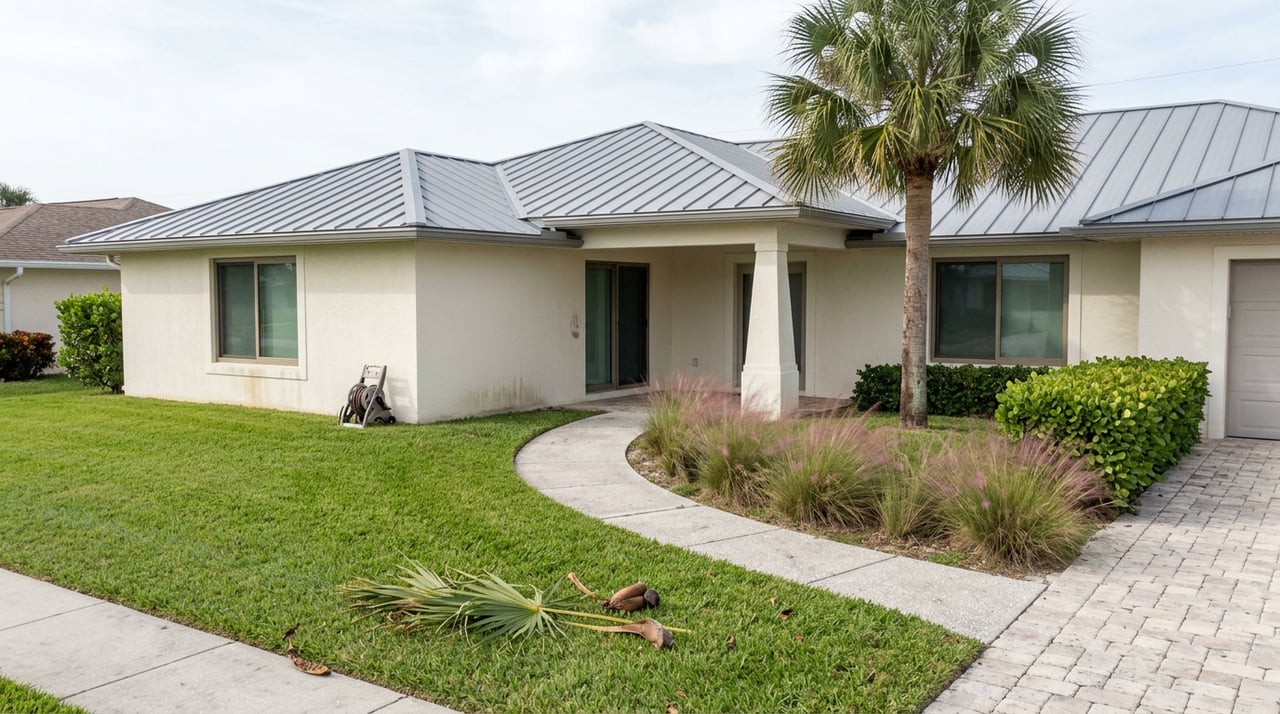
Why Cocoa Beach's Median Home Price Depends On Which House Happened To Sell
September 3, 2026
September 3, 2026
Search "Cocoa Beach home prices 2026" and you will find at least three defensible answers. One report puts the median sale price at $426,000 as of March 2026, down more than a third from the year before. Another shows $637,500 as of late August 2026, up over 12 percent year over year. A third has the citywide median sitting at $495,000 for the same August window. None of these numbers is wrong. They are measuring the same small city at different moments, and in Cocoa Beach, the moment matters more than almost anywhere else on the Space Coast.
That is not a data quality problem. It is a volume problem, and once you understand it, the "median" stops being confusing and starts being useful.
Cocoa Beach does not sell homes at a pace that supports a stable monthly average. In March 2026, only 32 homes closed across the entire city. In May 2026, that number rose to 121. In August 2026, it was 51. Compare that to a mainland market like Cocoa proper, which tracked 174 closings in a recent six-month stretch, or roughly 29 per month, a pace that at least starts to smooth out individual outliers.
When your monthly sample is 30 to 50 transactions, one $3 million oceanfront closing or one $2 million riverfront estate can shift the median by tens of thousands of dollars without any underlying home actually gaining or losing value. This is exactly what one local market report acknowledged directly: a widely cited price drop earlier in 2026 reflected a shift in the mix of homes that happened to close, specifically fewer luxury riverfront properties, and not a decline in what any individual property was worth. The same report noted that earlier in the year, closings at a well-known luxury condo building had skewed the citywide number upward for the same reason, in reverse.
If a single building's closing calendar can swing a citywide median by six figures, the median was never describing your house to begin with.
The bigger reason the numbers disagree is that Cocoa Beach is not one housing market wearing one median. It is two markets, single-family homes and condos, and for most of 2026 they have moved in opposite directions.
Single-family homes have been scarce and fast. In December 2025 data, the single-family median sat at $815,000, up 21.2 percent year over year, with only 52 homes listed for sale citywide, roughly six months of inventory concentrated in a very thin pool. By March 2026, single-family homes were selling in an average of 24 days, down from 102 days the prior March. That is not a market cooling. That is a market where buyers who want a permanent, non-vacation single-family home are competing hard for a genuinely small number of listings.
Condos have told the opposite story. Over that same window, condo sales volume rose 150 percent year over year as inventory expanded and buyers who had been priced out or waiting on the sidelines came back in, largely paying cash. In the December 2025 reporting period, 60 percent of condo purchases were cash deals, and cash transactions were up 400 percent from the year before, a pattern consistent with retirees and investors who are largely unbothered by financing costs. Condos have also taken longer to sell, averaging 55 days in March 2026 versus 24 days for single-family homes in the same month, and nearly half of the city's active listings had cut their asking price by that point.
Here is what that split looks like across a few points in the year:
| Snapshot | Single-family homes | Condos |
|---|---|---|
| Typical time to sell (March 2026) | 24 days, down from 102 days the prior March | 55 days on average |
| Median list price (August 2026) | $998,500, up from $644,450 in August 2025 | $427,500, up from $392,000 in August 2025 |
| Inventory conditions (December 2025) | About 6 months of supply, held tight by just 52 active listings | Sales volume up 150% year over year as available inventory grew |
Notice that single-family list prices actually climbed sharply between August 2025 and August 2026, even as some citywide sold-price reports showed declines earlier in the year. Both things are true at once. It depends entirely on which property type, and which month, you happen to be reading.
The luxury end of Cocoa Beach's market is small enough that individual sales function almost like named events rather than data points. A January 2026 market report highlighted a 6,005-square-foot full-floor oceanfront unit at Ocean Cove Condominium that closed at $3,090,000, alongside a 5,368-square-foot oceanfront single-family home in Melbourne Beach that closed at $2,700,000. Sales like these carry outsized weight in a city where total single-family volume can be as low as 32 transactions in a month. Add or remove one of them, and the citywide median moves by an amount that has nothing to do with how any other homeowner's equity changed that month.
This is the piece most portal-level price trackers miss. They report a single median for the entire city and treat it as a temperature reading, when in a market this thin it behaves more like a coin flip weighted by whichever handful of closings happened to record that period.
Part of why condos are behaving so differently from single-family homes traces back to a change in state law, not just buyer taste. Florida's SB 4-D, passed after the 2021 Champlain Towers South collapse in Surfside, requires condo and co-op buildings three stories or taller to complete structural milestone inspections once they reach 25 or 30 years of age, depending on coastal proximity. As of January 1, 2026, associations are also required to fully fund structural reserves and can no longer vote to waive that funding.
For Cocoa Beach's older oceanfront buildings, many of which are exactly the age this law targets, that has meant new special assessments or higher monthly dues layered on top of already-rising insurance costs. Buyers have responded by getting selective: turnkey units in buildings with clean inspection records and funded reserves still move, while units in buildings facing pending assessments sit longer and see deeper price cuts. That selectivity, more than any citywide sentiment shift, is a real driver of the longer condo marketing times and price softening showing up in the 2026 data.
If you are weighing Cocoa Beach against Satellite Beach, Melbourne Beach, or Port Orange using a single median price per city, you are comparing numbers that were built differently. Cocoa Beach's median is more volatile than most because its transaction volume is lower and its price range, from smaller inland condos to full-floor oceanfront units, is wider relative to that volume.
The useful question is not "what is Cocoa Beach's median price right now." It is "what are single-family homes and condos each doing right now, and which one am I actually shopping for." A buyer chasing a permanent single-family home should expect competition, tight inventory, and homes that move in weeks rather than months. A buyer or investor open to a condo has more room to negotiate, more inventory to choose from, and a genuine need to check a building's reserve funding and inspection status before writing an offer, since that status is now driving price and marketing time as much as location does.
Is Cocoa Beach currently a buyer's market or a seller's market? It depends on what you're buying. Single-family homes have leaned toward sellers for most of 2026, with tight inventory and fast sales. Condos have leaned toward buyers, with longer marketing times, more price cuts, and sellers more willing to negotiate.
Why did I see two reports with medians $200,000 apart for what looks like the same period? Most likely a mix effect. When a small number of luxury closings enters or drops out of the sample, the median can swing by that much even though individual home values haven't moved.
Should I wait for condo prices to fall further before buying? That depends on the specific building more than the calendar. Reserve funding requirements are structural, not seasonal, so buildings that are behind on compliance are likely to keep facing pressure regardless of when you buy, while well-funded, updated buildings have already stabilized.
If you're trying to figure out what a specific budget actually buys in Cocoa Beach right now, the citywide median won't tell you. A property-type-specific comparison will. Reach out to Ray Giamporcaro for a current read on the segment you're actually shopping in, or start with an instant home valuation to see where your own numbers land against this year's real activity.
Stay up to date on the latest real estate trends.
Get assistance in determining current property value, crafting a competitive offer, writing and negotiating a contract, and much more. Contact Ray today to discuss all your real estate needs!