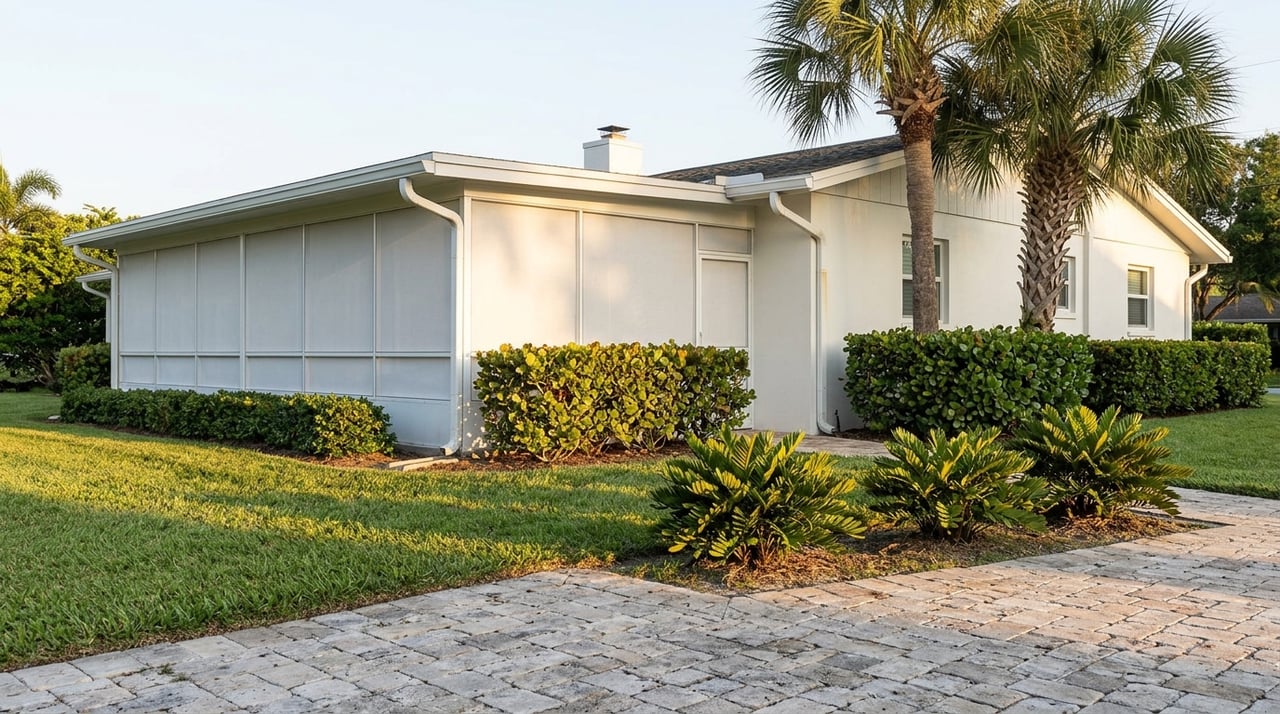
Satellite Beach Home Insurance Roof Age Explained
August 27, 2026
August 27, 2026
What happens to a sixteen-year-old roof the moment its house changes hands?
Nothing happens to the shingles. The nail pattern doesn't shift. The flashing around the chimney doesn't age a day faster because a new name goes on the deed. But the insurance math resets completely, and that reset is where a growing number of Satellite Beach closings are running into trouble this year.
Here's the mechanism most buyers and sellers never think about until it's sitting in front of them at bind time. Florida law protects existing policyholders from being dropped over roof age alone. Under Florida Statute 627.7011, an insurer can't refuse to renew a homeowner's policy solely because a roof passed the 15-year mark, provided a certified inspection shows at least five more years of useful life. That protection has kept a lot of long-tenured owners in South Patrick Shores and the rest of Satellite Beach insured on roofs their carrier would never touch as a fresh application.
That's the catch. A renewal and a new application are not the same event under most carriers' underwriting rules. The statute constrains how an insurer treats a policy it already wrote. It does far less to obligate that same insurer, or any other, to write a brand new policy on a roof already past 15 years old. So when a South Patrick Shores ranch changes hands, the buyer isn't stepping into the seller's insurance history. They're starting from zero, on the same physical roof, under a new-business underwriting standard that tends to be stricter than the one protecting the person selling it to them.
Ask a Satellite Beach buyer what "the inspection" covers and most will describe one visit: someone walking the attic, testing outlets, running the AC, checking for active leaks. That's the general home inspection, and it's the one buyers order during their contract's due diligence period to decide whether to move forward, renegotiate, or walk.
It is not the same review your insurance carrier runs.
For homes 20 years or older, many carriers require a separate four-point inspection that looks at exactly four systems: roof, electrical, plumbing, and HVAC. It doesn't care whether your kitchen was updated in 2019 or whether the pool deck needs resealing. It exists to answer one question for the underwriter: is this house an acceptable risk. A wind mitigation inspection is a third, separate visit that documents features like roof shape, roof-to-wall connections, and opening protection, and it feeds discount calculations rather than a pass or fail.
| Inspection | Who orders it | What it actually decides |
|---|---|---|
| General home inspection | Buyer, during due diligence | Whether to proceed, negotiate repairs, or terminate the contract |
| Four-point inspection | Often required by the carrier for homes 20+ years old | Whether the carrier will issue or renew a policy at all |
| Wind mitigation inspection | Buyer or seller, usually optional | How much of a premium discount the policy qualifies for |
A roof can sail through the first one and still get flagged on the second. That's not a hypothetical. Buyers under contract on older Brevard County homes have described exactly this scenario: a roof with a decade and a half of visible life left passes the buyer's own inspection cleanly, then gets flagged the moment it hits a carrier's underwriting model, because the model is scoring age against an internal threshold, not the roof's actual condition.
There was a legislative fix on the table this year that would have closed part of this gap, and it's worth knowing it didn't survive.
House Bill 815 and its Senate companion, SB 808, would have extended the 15-year renewal protection beyond standard homeowner policies to cover condo association policies and landlord policies too. Both bills died in the Insurance and Banking Subcommittee on March 13, 2026. The existing protection under 627.7011 stays exactly where it was, which means the coverage gap for rental property owners and condo associations that the bill was written to close is still open. If you're a landlord or an investor holding rental property in Satellite Beach, your roof doesn't get the same statutory footing a standard owner-occupied policy does, and that's true today the same way it was true in January.
The one piece of real relief that did land this year came from a different direction. Citizens Property Insurance Corporation, the state's insurer of last resort, implemented an average rate reduction of about 8.8 percent on multiperil policies and 5.5 percent on wind-only policies effective July 1, 2026. That's genuine money back for anyone already parked on Citizens because a private carrier declined to renew them. It doesn't change the new-business underwriting problem for a buyer trying to insure a roof for the first time.
Satellite Beach's housing stock isn't uniform, and that matters here. South Patrick Shores, the unincorporated stretch between Patrick Space Force Base and the beach, is still largely built out from the 1960s through the 1980s, when Cape Canaveral's Mercury, Gemini, and Apollo years pulled engineers, technicians, and military families onto the barrier island in a hurry. A lot of those original ranch homes are still standing, and a lot of them still have original or first-replacement roofs pushing past the 15-year line.
Salt air makes the timeline shorter than it would be a few miles inland. Air conditioning condensers can show serious corrosion in as little as five to seven years this close to the ocean, and hurricane straps and roof-to-wall connectors face the same exposure. None of that shows up as an active leak or a failed outlet on a general home inspection. It shows up when a wind mitigation inspector or a four-point inspector is specifically looking for it, which is exactly why the two reviews can produce two different verdicts on the same house.
Contractors who work the area regularly point to the same pattern from a different angle: pre-1985 homes tend to need electrical service upgrades, anything built before 2002 tends to need hurricane-code envelope work, and homes with original kitchens and baths carry a resale penalty against buyers who increasingly expect move-in ready. The renovation math and the insurance math are pointing at the same houses for the same reason.
Every tracker reading Satellite Beach right now shows homes taking longer to sell than they did a year ago, though the trackers don't agree on exactly how much longer, which is itself worth understanding. Over the three months ending May 2026, homes were selling after a median 82 days, up from 50 days over the same window a year earlier. A separate July 2026 read put the average at 103 days against 91 days last year. A third source tracking July 2026 closings put it at 79 days versus 65 the year before.
Those numbers won't reconcile because Satellite Beach is small enough that a handful of sales can swing a monthly median hard in either direction. But the direction is consistent across every source: homes are sitting longer this summer than last. Rising days on market usually gets read as buyers pulling back on price. In a market with this much aging inventory, it's also consistent with something more specific: contracts stalling out at the insurance step rather than the negotiation step, especially on the older stock where a roof that looks fine on a walkthrough turns into a scramble once a carrier's underwriting model gets involved.
If you're selling an older home here, get your roof's age and your most recent four-point inspection result ready before you list, not after an offer lands. If a buyer's lender asks for proof of insurance late in the process and the carrier balks, you're now negotiating a roof replacement or a price adjustment on a compressed timeline instead of on your terms.
If you're buying, pull insurance quotes during your inspection period, not after you've waived contingencies. Order a wind mitigation inspection alongside your general home inspection rather than treating it as an afterthought. And if the roof is past 15 years, ask directly whether coverage would be Replacement Cost Value or Actual Cash Value, because that distinction determines what you actually collect if a storm damages that roof five years into ownership, not just whether you can get a policy at all.
Does this apply to condos too? Not the same way. The statutory renewal protection under 627.7011 covers standard homeowner policies. Condo association master policies and landlord policies fall outside that protection, and the bill that would have closed that gap died in committee this spring.
If my roof is under 15 years old, am I in the clear? Largely, yes, for the statutory piece. An insurer can't refuse to issue or renew solely because of age under the 15-year mark. Condition still matters. A young roof with visible damage or poor installation can still get flagged on its own merits.
Can I still buy an older South Patrick Shores home with confidence? Plenty of buyers do it every month. The difference is sequencing. Quote the insurance before you're locked into a closing date, not after.
None of this means older Satellite Beach homes are a bad bet. It means the sequence matters more here than it does in a newer subdivision inland, and the sequence is exactly the kind of thing that's easy to get right with the right guidance and easy to get expensive without it. If you're weighing a purchase or a sale on the barrier island and want someone who already knows where these roof-age snags tend to show up, reach out to Ray Giamporcaro and The SunSpot Team before you write or accept an offer.
Stay up to date on the latest real estate trends.

Get assistance in determining current property value, crafting a competitive offer, writing and negotiating a contract, and much more. Contact Ray today to discuss all your real estate needs!